
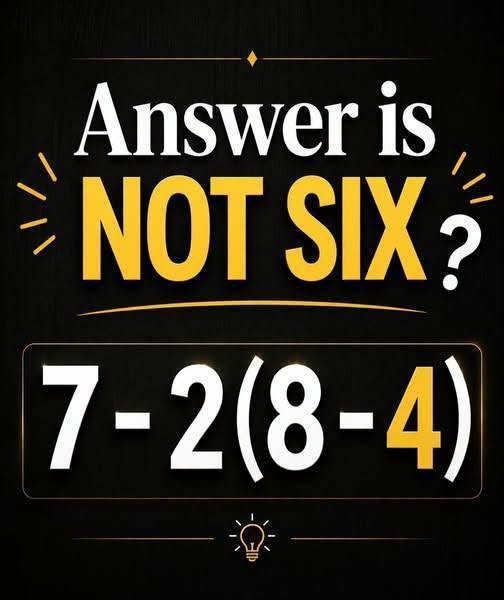
Final Answer: -1
💡 Key Rule: In mathematics, an expression like 2(4) carries the exact same priority as 2 × 4. It is not a separate operation that waits until after subtraction. Multiplication (explicit or implied) always precedes addition/subtraction.
🚫 Why People Get It Wrong (The Real Traps)
The puzzle isn’t hard. It’s deceptive. Here’s why thousands land on the wrong answer:
Wrong Answer
How People Arrive at It
Why It’s Incorrect
20
Left-to-right processing: 7 – 2 = 5, then 5 × 4 = 20
Breaks the order of operations. Multiplication must happen before subtraction.
6
Misreading the equation or treating 2(4) as 2 + 4 → 7 – 2 + 4 = 9 (then miscounting), or confusing it with similar viral equations
Ignores multiplication entirely or misapplies grouping rules.
-5
Correct parentheses: 7 – 2(4), but subtracts 2 from 4 first → 7 – 2 = 5, then 5 – 4 = 1 (or similar arithmetic slip)
Fails to multiply before subtracting.
The Biggest Culprit: Left-to-Right Bias
Our brains are wired to read and solve sequentially. When we see 7 – 2(4), the instinct is to subtract 2 from 7 first. But math doesn’t work like reading a sentence. It works like a recipe: you must complete certain steps before others, regardless of order on the page.
📐 PEMDAS / BODMAS: The Rulebook You Learned (But Maybe Forgot)
This puzzle hinges on one foundational concept: the order of operations.
Acronym
Meaning
PEMDAS (US)
Parentheses → Exponents → Multiplication/Division → Addition/Subtraction
BODMAS (UK/Commonwealth)
Brackets → Orders (exponents/roots) → Division/Multiplication → Addition/Subtraction
Important Notes:
✅ Multiplication & Division are equal priority → solve left to right
✅ Addition & Subtraction are equal priority → solve left to right
✅ Implied multiplication a(b) has the same priority as a × b
✅ Parentheses/brackets always come first
When applied correctly, 7 – 2(8 – 4) leaves no room for debate.
📱 Why Do Calculators Sometimes Disagree?
If you typed 7 – 2(8 – 4) into your phone’s calculator and got 20, here’s why:
Calculator Type
How It Processes Input
Result
Basic Calculator
Follows strict left-to-right entry
20
Scientific/Graphing Calculator
Follows PEMDAS/BODMAS automatically
-1
Computer/Programming Languages
Follow strict operator precedence rules
-1
🔧 Pro Tip: Always use a scientific calculator, spreadsheet, or math app for mixed operations. Basic calculators are designed for sequential arithmetic, not algebraic rules.
🌐 Why These Puzzles Go Viral
Math puzzles like this aren’t really about advanced mathematics. They’re engineered to trigger:
✅ The Confidence Trap: “I learned this in 5th grade! It’s easy!” (Then the brain shortcuts)
✅ The Engagement Loop: Disagreement drives comments, shares, and algorithmic visibility
✅ The Nostalgia Factor: Reminds us of school rules we haven’t used in years
✅ The “Gotcha” Effect: Makes people feel clever when they “figure out the trick”
They’re less about testing intelligence and more about testing attention to detail. And honestly? That’s what makes them fun.
❓ Frequently Asked Questions
Q: Is implied multiplication 2(4) treated differently than 2 × 4?
A: In modern standard mathematics, no. Both have equal priority and are solved before addition/subtraction. Some older regional curricula treated implied multiplication as higher priority, but that’s largely obsolete in standardized testing and professional math.
Q: Why do so many people insist the answer is 20?
A: They’re applying left-to-right processing, which works for basic arithmetic but breaks down when multiple operation levels are mixed. It’s a common habit, not a mathematical rule.
Q: Could the answer ever be something else?
A: Only if the equation is written differently (e.g., (7 – 2)(8 – 4) = 20 or 7 – (2 × 8) – 4 = -13). With the exact syntax 7 – 2(8 – 4), -1 is the universally accepted answer in modern mathematics.
Q: Does this matter in real life?
A: Absolutely. Order of operations is foundational in engineering, programming, finance, physics, and data science. A misplaced assumption can change a bridge design, a financial model, or a software algorithm.
Q: How can I avoid falling for these traps?
A: Pause. Identify operation levels. Solve parentheses first, then multiplication/division, then addition/subtraction. When in doubt, add parentheses to clarify: 7 – (2 × (8 – 4)).
💡 A Final Thought
If you got -1 on your first try: congratulations. You remembered the rules.
If you got 20, 6, or anything else: you’re in good company. Millions make the same mistake, and that’s exactly why these puzzles spread.
Math isn’t about memorizing tricks. It’s about shared conventions. When we all agree on the rules, 7 – 2(8 – 4) will always equal -1, no matter who solves it, where they’re from, or what calculator they use.
So next time a viral equation blows up your comments section:
🔹 Slow down
🔹 Follow the order of operations
🔹 Trust the system over your first instinct
And remember: the goal isn’t to be “right” faster than everyone else.
It’s to understand why the answer is what it is.
Because in math, as in life, clarity beats confidence every time.
Did you solve it correctly on your first try? What other viral math puzzles have tripped you up? Share your thoughts, tips, or favorite math myths respectfully in the comments below. 🔢
ADVERTISEMENT

